



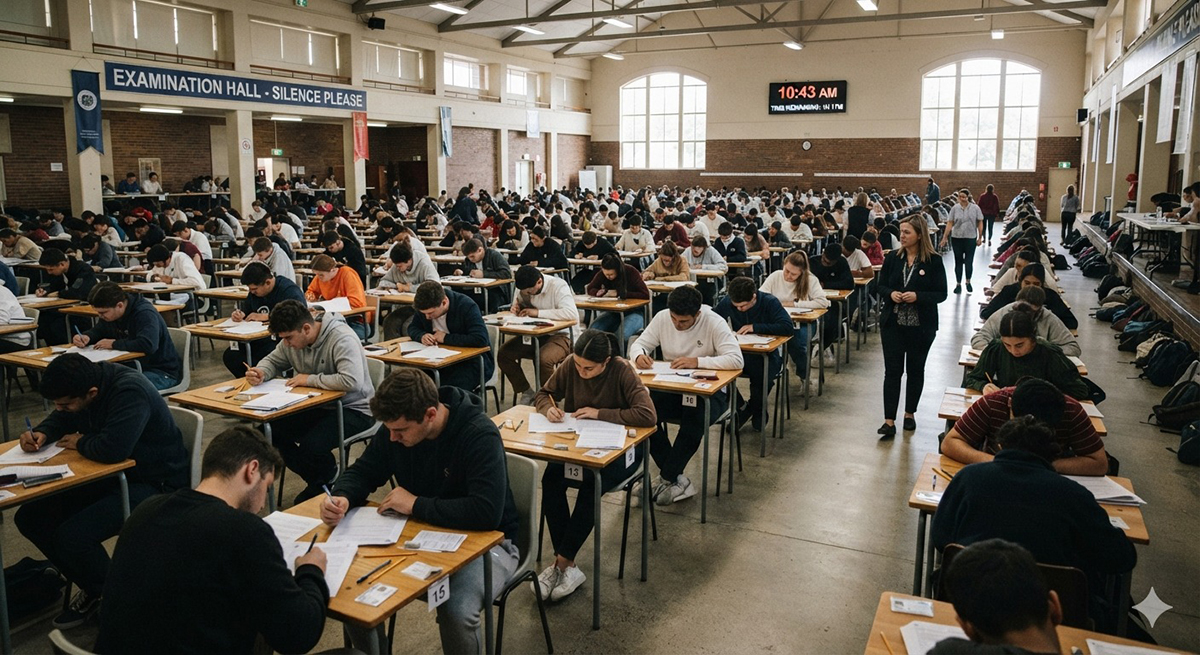
Rethinking the high-stake education pressure
Every year, national competitive exams like the National Eligibility cum Entrance Test (NEET) and the Joint Entrance Examination (IIT JEE) attract millions of aspiring students from across India. For many families, especially those from the middle class, securing a seat in a government medical or engineering colleges (IIT/NIT) seems the ultimate goal and social prestige and a secured future. However, this intense attraction has turned secondary education into a hyper-competitive zone, raising critical questions about systemic social pressure, student well-being, and the value we place on human life.The Illusion of the "Best" Education (NEET)
While pursuing a Bachelor of Medicine and Bachelor of Surgery (MBBS) or an IIT engineering degree is highly respectable, viewing them as the only premier Institutions in India is a major misconception. India offers incredible professional opportunities in fields like biotechnology, law, design, data science, and management. Despite this diversity, many parents still continue to heavily pressurize their children to prefer traditional professional courses like medicines and engineering. This pressure stems from a rigid mindset that equates success solely with medicine or engineering, often ignoring a child's individual interests, strengths, and passions.The math of despair and the Impact of paper Leaks in NEET
The core crisis of these national exams lies in a stark demand-and-supply mismatch. With millions of candidates competing for a limited pool of seats, the vast majority of students will mathematically not qualify, regardless of their hard work.When a system is already such strained, the systemic aberrations like the question paper leaks, laxity, corruption, and sudden testing irregularities deal a serious blow to student morale. For a middle-class student who has sacrificed years of comfort, family savings, and mental peace, a compromised exam feels like an insurmountable, unfair barrier. The resulting frustration, helplessness, and hopelessness can unfortunately lead to tragic instances of student suicides.
Comparing the Toll: NEET vs. IIT JEE
While both exams push students to the brink of academic burnout, recent data highlights distinct differences in the psychological toll between NEET and IIT JEE aspirants. A simple news reading gives us an idea that the student suicide trends tilt more towards the NEET aspirants than towards the JEE aspirants.NEET Aspirants
The reasons may be that the students who start preparing for the medicine course has to opt Biology as a compulsory subject from 10th -12th standard. When he takes Biology as a compulsory subject, his opportunity in another professional course gets narrowed. While preparing the NEET the candidate opts for drop years and repeats. Multiple drop years are very common and socially accepted by parents. During the period, the student feels intense isolation and anxiety which is beyond others’ perception. Further if the student misses the Govt medical seat, the private medical college seats are financially difficult or unviable for the most the middle-class families. Then the actual problem starts for the middle-class family which is compounded by the paper leaks.
IIT JEE Aspirants
The students opting for the IIT/NIT (govt engineering) colleges opt math as the compulsory subject in 10th -12th standard. A student failing to get admission to IIT has alternative options. He may get into NITs, IIITs, or top-tier private engineering universities. Drop Years / Repeats: Strictly capped by years & attempt limits, preventing students from spending 4–5 years trapped in the same loop. This data shows that while JEE students face immense stress while the NEET aspirants face a uniquely suffocating bottleneck due to the lack of viable, affordable alternatives if they fail to secure a government medical seat.
Life is more Precious than a professional Career?
I will say yes. yes, human life, health, and personal well-being of a young student are fundamentally more precious than a professional career.
It is essential to state clearly and unequivocally that suicide is never the final step, nor is it the answer. No examination, career, or educational degree is ever more precious than a human life. An exam is merely a test of a specific set of academic skills on a given day; it is never the reflection of a child's worth, intelligence, or future potential.
To prevent these tragedies, children need unconditional trust and emotional support from their parents. Instead of carrying the heavy burdens of familial expectation, students need to know that their family's love is not tied to a rank list. Parents must build a home environment where failure is treated as a temporary setback and a natural part of life, rather than the end of the road. The parents must show them the different opportunities for future career.
The Need for Systemic and Government Reform
While emotional support at home is crucial, the government must address the root cause of the crisis. To meet the growing healthcare needs of India's population and ease the extreme competition, the government need to aggressively expand public medical infrastructure. Setting up more medical colleges and expanding available seats would automatically accommodate more deserving MBBS students, lower the artificial inflation of cut-off scores, and systematically reduce the toxic levels of stress surrounding the exam. It means the govt must spend more on education which is badly missing at present. To my mind paper-leaks solely points out to the age-old chronic problem of the society and that is leading to corruption. To my mind corruption is the abuse of power/position/work for personal gain. I have seen corruption in different places, methods and occasions. Our present society is an averagely corrupted one. The Government can make the infrastructure robust and leak-proof in term of technology, but the people who are handling the question paper setting are the key. Even one part of the chain of the people if adopts a corrupt approach then the system fails for which the entire system is blamed and punished. Many paper-leaks have happened but due to one or two culprits, the entire system is defamed and the trust deficit develops among the student’s community. Corruption should not be limited to only paper-leaks, it is very much prevalent in the education system in form of favouritism by the academic administration. Faculty favours the students in their annual exams for their own interest. The supervisors too favour their select PHD scholars for their mutually agreed interests, even in recruitments too. So, corruption has been an inbuilt component of the system and the system are driven by the people who implement it. The candidate who would pass through the system will obviously follow the path of corruption more or less. Hence, we must need an education system which will be driven by honest people.
Ultimately, education should be a pathway to growth, not a source of trauma.
Society, parents, and policymakers must work together to ensure that the youth can pursue their dreams without sacrificing their mental health and lives.